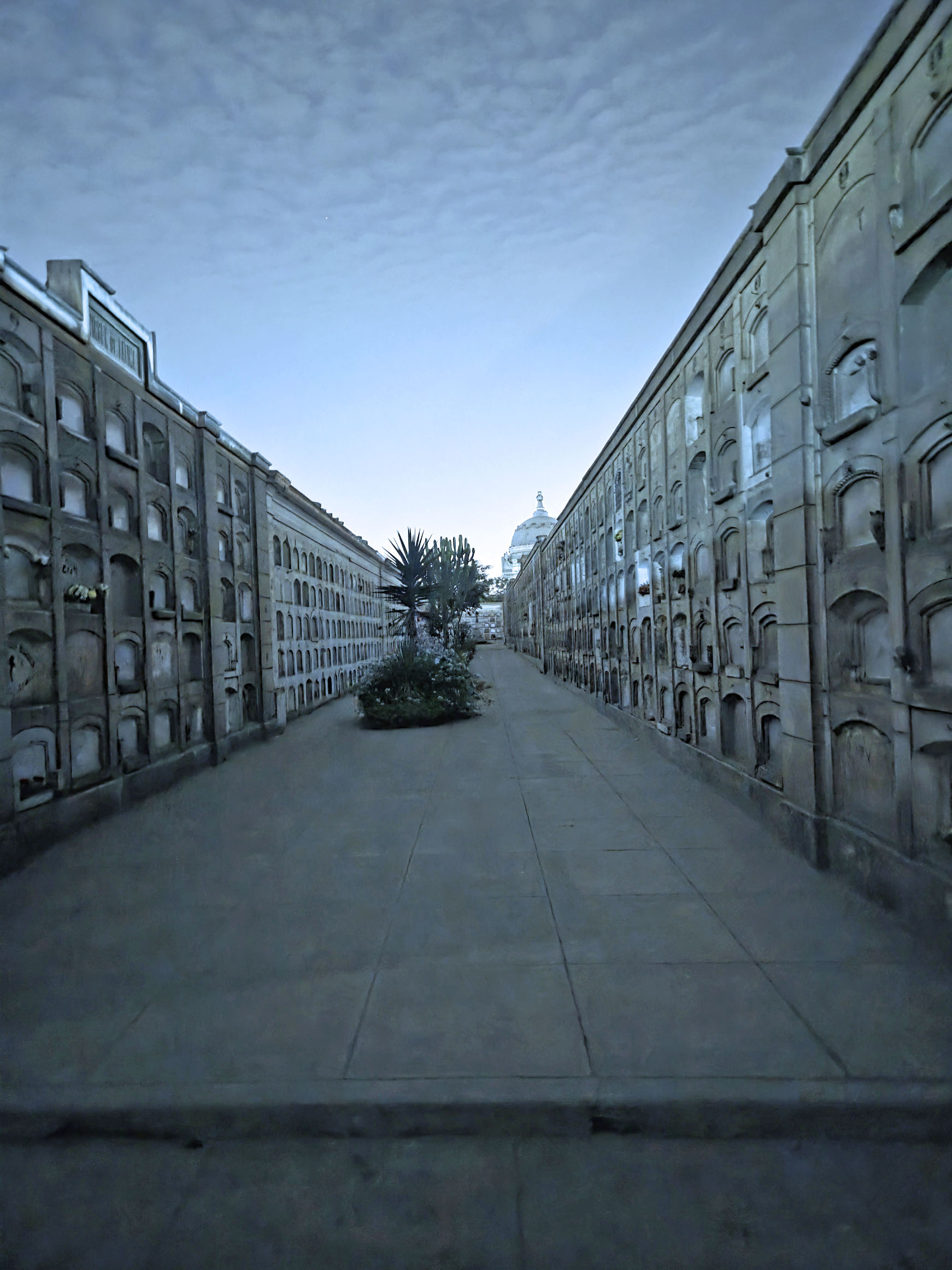
When my husband Daniel found out that there is a moonlight tour of Lima’s Cementerio Presbítero Matías Maestro, we had to go! We invited his sister Neta to come with us and then we booked a tour.
Getting There
We drove for an hour through Lima’s hellish rush hour traffic, arriving just before sunset. We could have taken the metro, which has a stop a couple hundred meters from the cemetery entrance. In fact, the metro station is named for the cemetery and occupies a sliver of land that used to be part of the cemetery. The metro would have been a lot quicker, but it is also hellishly crowded at rush hour. As Daniel seems to derive a perverse pleasure in driving through Lima’s traffic, Neta and I were happy to let him drive while we enjoyed riding in a comfortable and uncrowded car.
The security guards opened the cemetery gates to let us park inside the entrance. We bought snacks from a sidewalk vendor, found a bench to sit on, and ate our snacks while we waited for it to get dark.
By 8:00 P.M. a few dozen other people had arrived and the tour began.
Some History
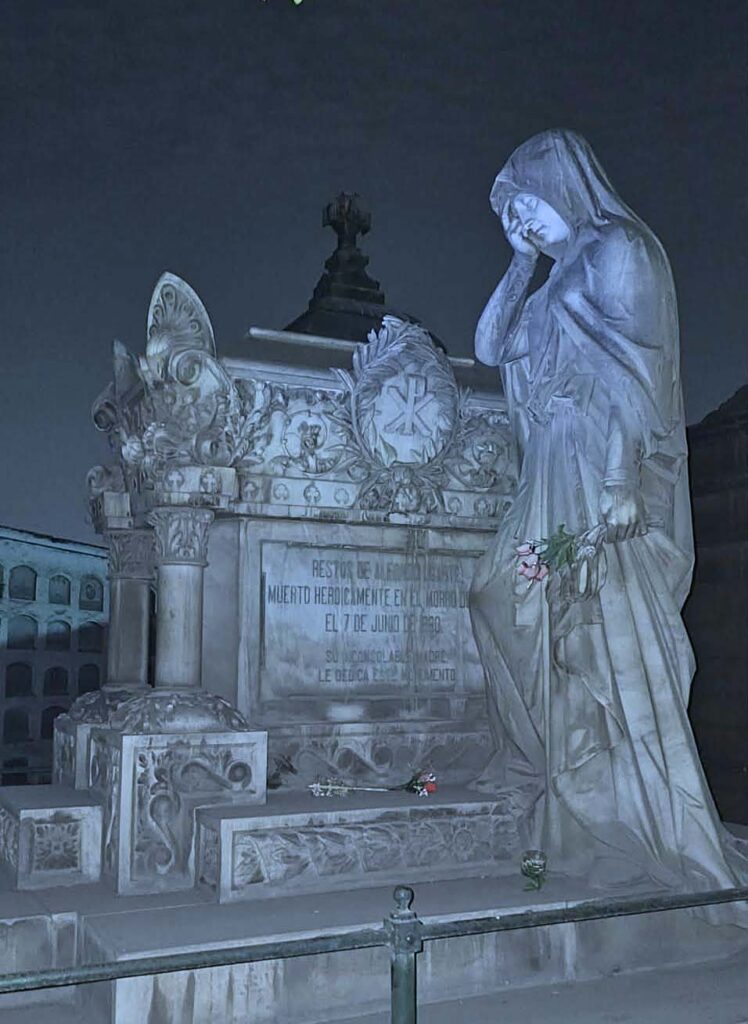
Our guide began the tour with a brief overview of the history of the cemetery. It dates from late colonial times: 1808. Prior to that time, people were buried in catacombs underneath the churches.
Why did the Viceroy of Peru decide to build a big new cemetery outside the city walls? The project was controversial at the time and opposed by traditionalists, but there were several good reasons to build a new cemetery.
- Even though there were (and are) an enormous number of churches in Lima, their catacombs were filling up and the city needed to find more space for the dead.
- Suicides, Protestants and non-Christians couldn’t be buried inside a Catholic church but could be buried in a civil cemetery.
- The more enlightened of the citizenry realized that putting the dead in crypts was unhygienic and endangered the health of the community.
In 1923, the cemetery was renamed to honor its architect Presbítero Matías Maestro (1766-1835).
What Caught My Eye
This must be one of the most impressive cemeteries in the world! It is laid out like a city with avenues lined by apartment-like 5 story mausoleums and interspersed with showy mansion-like family crypts and ornate chapels.
Many of Peru’s most prominent citizens of the 19th and 20th centuries are buried here, so in that sense it is comparable to Pere Lachaise in Paris, Westminster Cathedral in London or Santa Croce in Florence.
Crypt of the Heroes
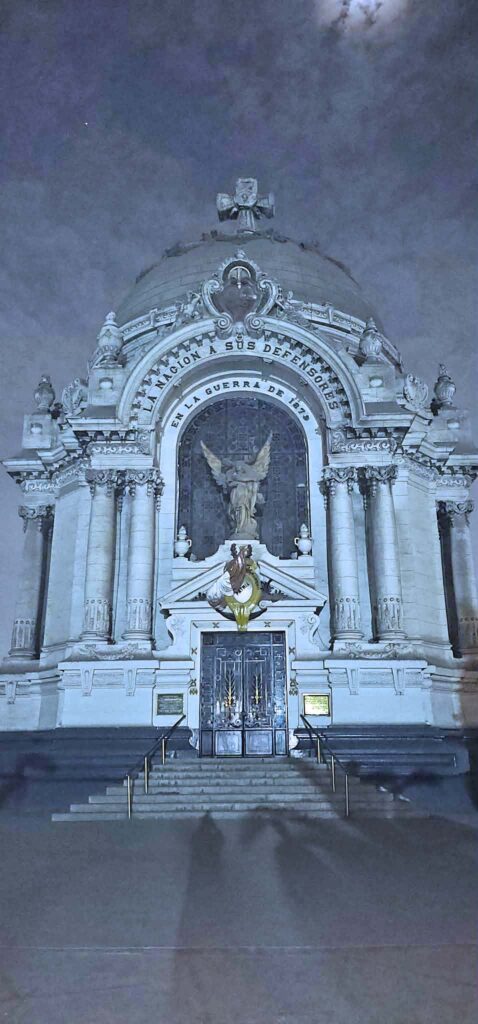
At 30 meters, the tallest structure in the cemetery is also the most impressive. This mausoleum is a memorial to the dead of the War of the Pacific. Located in the center of the cemetery, it is a fitting cathedral for this city of the dead.
A Mausoleum with Servants’ Quarters
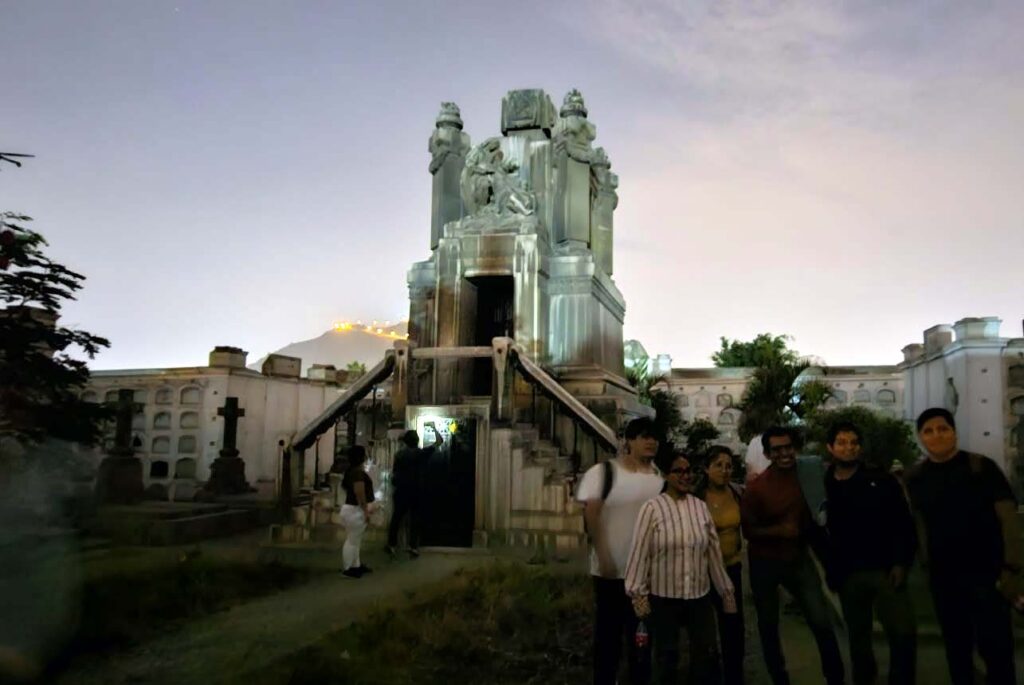
This mausoleum has an upstairs for the family and a downstairs for the servants.
Tomb of Eduardo de Habich
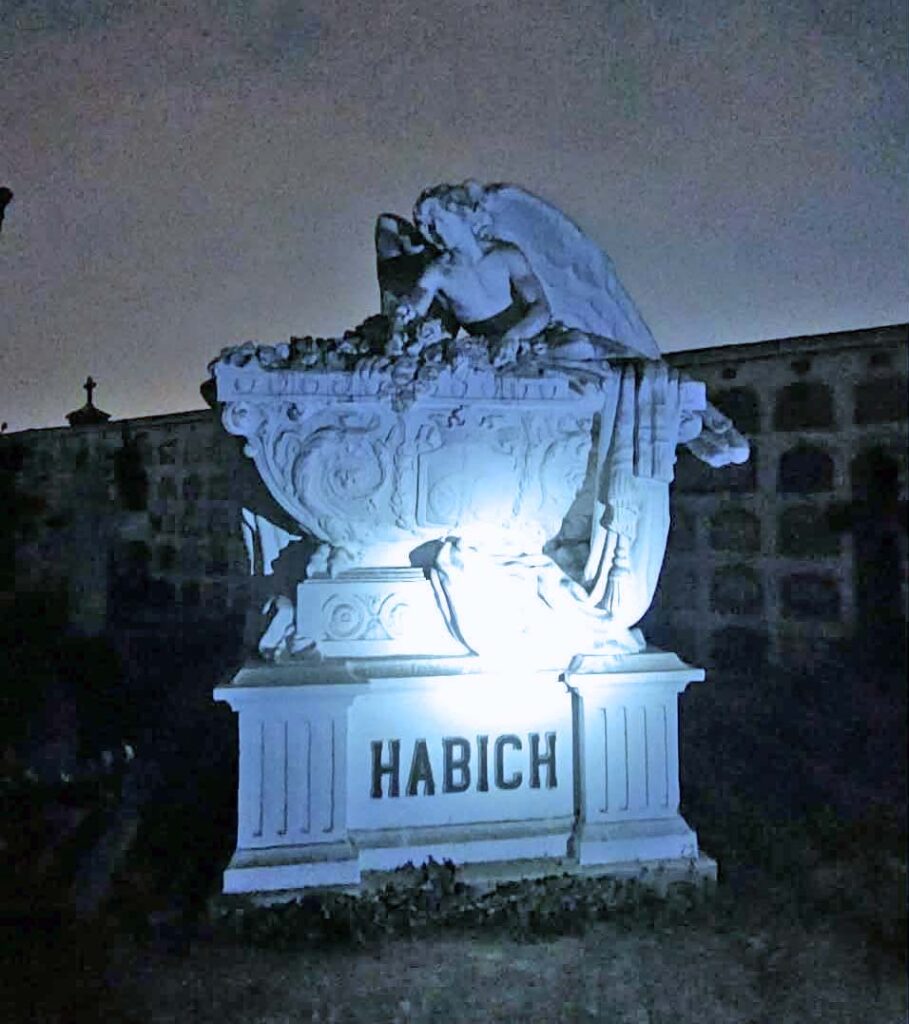
Eduardo de Habich (1835 – 1909) led a very interesting and productive life. He was a Polish engineer. He served in the Russian Army from 1852 to 1858, fighting in the Crimean War and taking part in the construction of the Kiev Arsenal. But after participating in the unsuccessful 1863 uprising of Poland against its Russian rulers, he fled to France. In 1869 he was hired by the government of Peru to provide engineering services to the government. He spent the rest of his life in Peru.
He is best known for establishing a school of engineering in 1876. Known today as UNI (Universidad Nacional de Ingeniería), it is one of Peru’s most prestigious educational institutions.
On a personal note, Neta’s sixteen-year-old son is very talented in math and science. He is getting excellent grades in high school and is studying hard to be admitted to UNI next year.
Supernatural Manifestations
The allure of a nighttime tour of the cemetery is the chance to observe supernatural manifestations: ghostly lights, cries of the dead, unexplained agitations of the atmosphere.
Ghostly lights
People often see ghostly lights emanating from certain areas of the cemetery. Our guide explained that these lights may not be apparent to the naked eye but, like the aurora borealis, can sometimes be captured by good cell phone cameras.
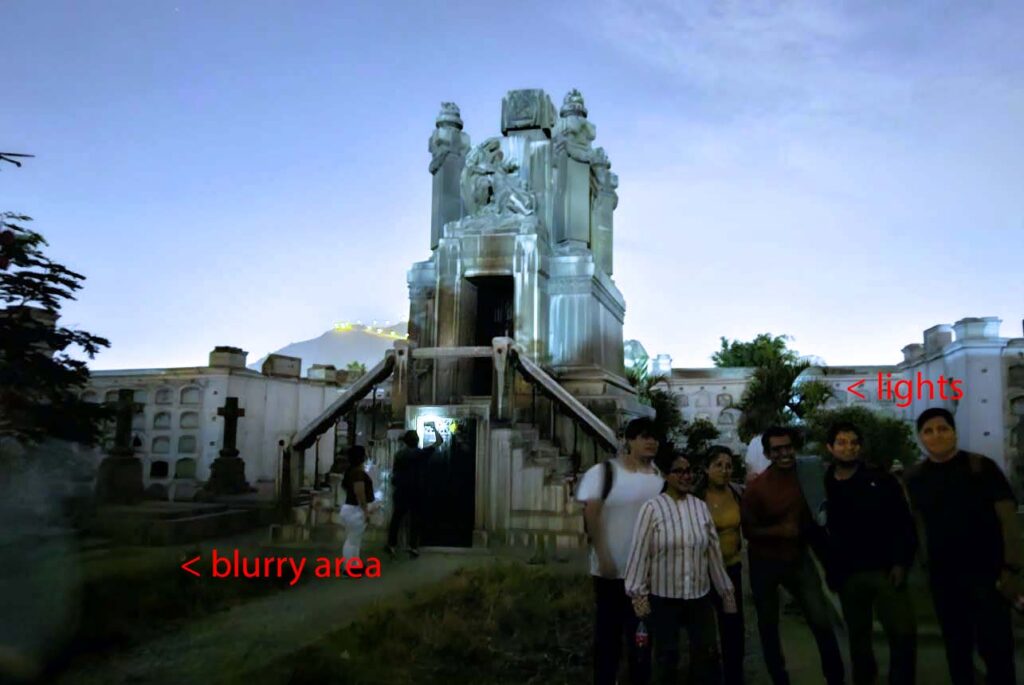
When I carefully examined the photo of the two-story mausoleum above using Photoshop, I noticed a couple of interesting phenomena. There are four ghostly lights that appear in the right side of the photo, in the tree behind the group of people. And the lower left-hand corner is completely blurry, even though the rest of the photo is reasonably sharp. (Note that the bright light at the door to the lower crypt is somebody taking a flash photo of the interior and is not in any sense supernatural).
Cries of Dead Children
As we walked through an area of the cemetery where children were buried, both Daniel and Neta heard their voices calling out for their mothers.
Mysterious Air Currents
We passed one mausoleum undergoing some reconstruction. The entrance was cordoned off by yellow tape. This tape was gently fluttering as if in a breeze – even though it was a perfectly still night!
Departing Thoughts
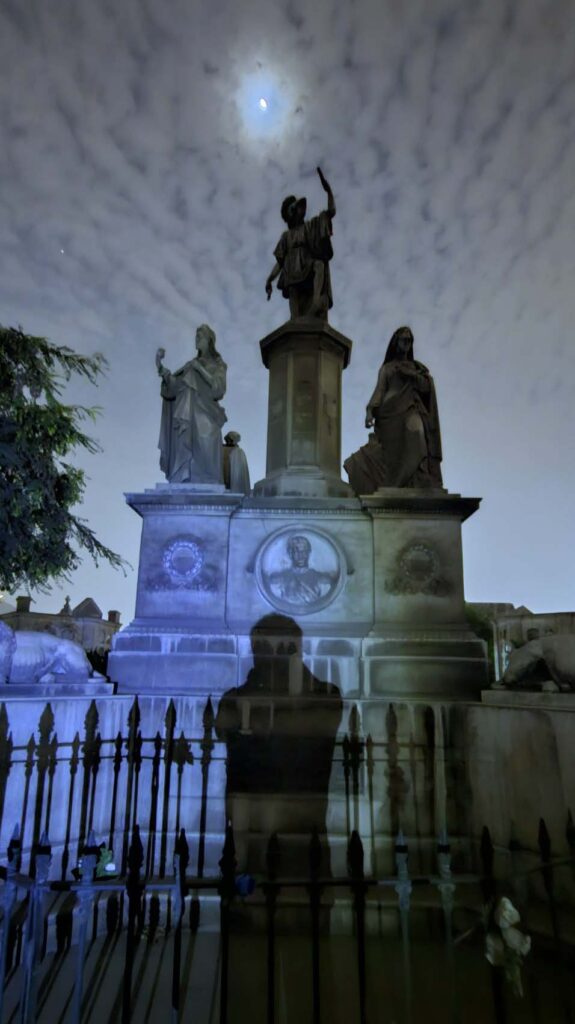
The tour ended at 11:00. As we drove back to the apartment, I pondered what I had experienced. Even though I didn’t perceive the ghostly lights and voices that Daniel and Neta did, I’m not a skeptic.
After all, as I sit here at my laptop, I know I am surrounded by Wi-Fi transmitting data to the internet and radio waves carrying music and speech. I can’t perceive any of this, but the machines that I use can. Is it really illogical to believe that there are things that exist that we are not equipped to perceive?